
A Guide to the
Disabled Students' Allowancefor Dyslexia
This guide helps parents and students understand and apply for Disabled Students’ Allowance (DSA), with the key steps and resources in one place.
DSA applications: how we support you at each step
We understand that the DSA application process can seem daunting — we are here to help.
The DSA path usually includes applying to your funding body, sharing evidence, attending a needs assessment, receiving your entitlement letter, and arranging equipment, software and training.
We can meet with you on Zoom for 30 minutes and help you prepare what to include. For dyslexia, a diagnostic report or assessment history is often enough as evidence.
If you are unsure which form to use or how to describe your study needs, we will help you map it to the student finance process for your nation.

What is the Disabled Students' Allowance?

The Disabled Students’ Allowance (DSA) is a grant that helps cover disability-related study costs, including support for dyslexia.
The grant is based on your needs, not your household income. It is not means tested and does not need to be paid back.
DSA is available to students with dyslexia across a wide range of needs and study contexts.
Who is the Disabled Students' Allowance for?
The DSA grant is available for students with:
- Specific learning difficulties such as dyslexia, dysgraphia, dyscalculia, ADHD, and autism
- Physical disabilities
- Mental health conditions (e.g. anxiety or depression)
- Long-term health conditions (e.g. cancer or heart disease)
This guide focuses on dyslexia support for higher education, and the same core steps can help when applying for other disability-related assistance.

You are eligible for DSA with dyslexia if you:
- Have a dyslexia diagnosis from school or adulthood
- Are studying full-time or part-time for at least one year
- Are an undergraduate or postgraduate student in the UK
- Qualify for student finance
Sending a PDF of your original diagnosis is usually enough for dyslexia evidence. A childhood report is valid and does not expire.
For some physical or mental health conditions, you may need a GP to complete the DSA evidence form.

What does the DSA grant cover?

Depending on your personal needs, the grant can cover practical tools and services that make study more accessible.
These resources help you build a setup that works with your way of learning and thinking.
- Assistive software:Mind mapping, text-to-speech, and other productivity tools.
- Hardware:Laptops, printers, and other required equipment.
- Study skills support:One-to-one sessions for writing, revision, and time planning.
- Other costs:Printing, photocopying, and training for recommended software.
How do you apply for DSA?
You can apply for DSA at the same time as your student finance application, or at any point during your course.
Apply as early as possible, ideally before you start university, so support is ready when teaching begins.

Here are the steps:

1. Contact your university's Disabilities and Wellbeing Team
This is the best first step. They can walk you through the process and help with the form.
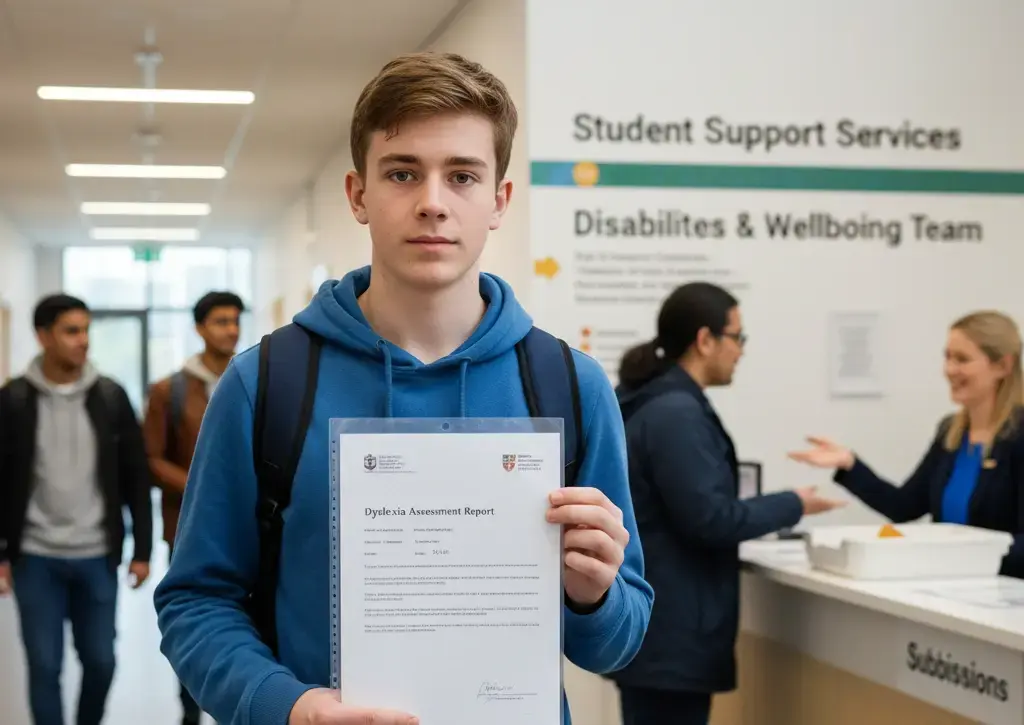
2. Find your dyslexia assessment
Look for a PDF in your email history or locate your paper report.

3. Apply online
You can apply with student finance or separately during your course.
Check the country links
4. Attend a needs assessment
You should usually hear back within a few weeks with next-step details.

5. Receive your award
You will get a DSA2 entitlement letter with approved support and supplier details.
Your Needs Assessment
Once your application is reviewed, you are invited to a needs assessment. This is a conversation about what support will help you study effectively.
It is not an exam. The goal is to recommend practical tools, software, and support based on your real study needs.
The recommendations from this assessment are used to create your DSA2 award letter.
To help you prepare, think about these questions:
- How does dyslexia affect you in daily study life?
- Do you find it difficult to take notes during lectures?
- How do you currently write essays, reports, or prepare presentations?
- Is time management or organisation a challenge?
- What strategies have helped you in the past?
- Are there tools or software options you already know would help?

The Award
This is not a pass/fail process. The aim is to identify support that matches your needs.
Your award letter lists what has been approved and explains how your supplier will deliver equipment, software, and support.

Do you have any DSA-related questions?

Further resources by country
The application forms and portals are different for each nation within Great Britain. Your application goes to the funding body that provides your student finance.
This means you might study in England, but if you are from Scotland your funding body is SAAS. The details for each nation are below.
- England:https://www.gov.uk/disabled-students-allowance-dsa/how-to-claim
- Scotland:https://www.saas.gov.uk/guides/disabled-students-allowance/how-to-apply-for-dsa
- Wales:https://www.studentfinancewales.co.uk/undergraduate-finance/full-time/tuition-fee-and-living-cost-students/what-s-available/disabled-students-allowance/
- Northern Ireland:https://www.studentfinanceni.co.uk/types-of-finance/undergraduate/full-time/tuition-fee-and-living-cost-students/extra-help/disabled-students-allowance/applying/